New Heights: A Design That Redefines How We Build
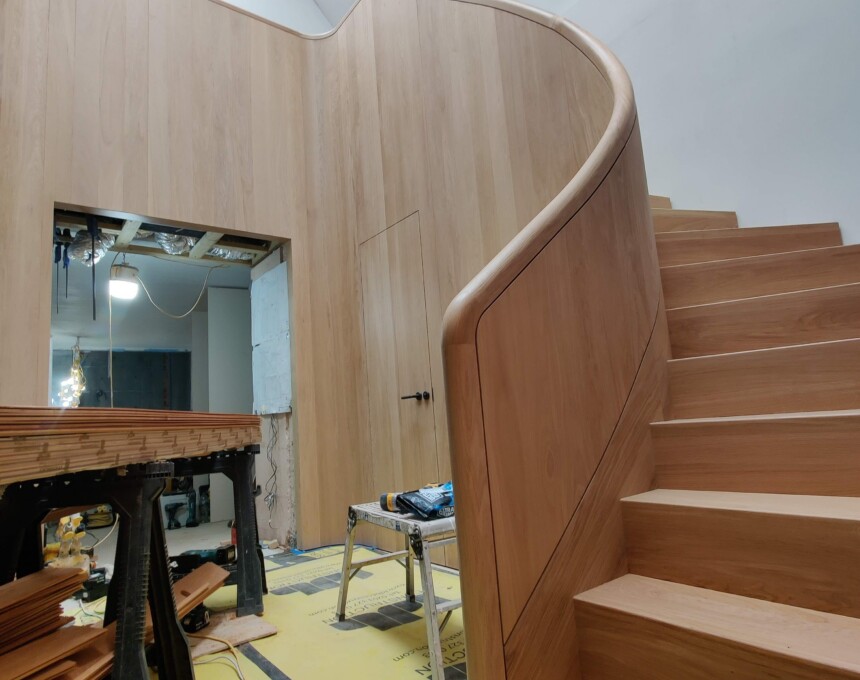
Staircase designs can be gorgeous, but some designs require us to step out of our comfort zone and try something new. This design, by McGuinness Architects, is an excellent example. For this Putney project, led by LDB Construction, we designed and manufactured a bespoke balustrade which is a blend of our framework for plasterboard balustrades and tongue-and-groove boards. The end result is stunning, but what a journey it was to make this design work.
A Lot to Consider
A new technique requires a lot of brainstorming. How do we make the tongue-and-groove planks curved? How do we get the handrail profile on top of the balustrade? How do we achieve the required thickness? How do we make a hidden door in the panel? How do we continue the design to the kitchenette in the far corner? How do we manufacture boards that are longer than 4 m and might not fit on our CNC? We had to consider hygrothermal conditions. As there is a water feature, we needed to make sure the extra humidity would not affect the staircase. We also had to think about how the staircase would react to the natural light in the space.

The Design
After a lot of consideration we came up with a the following: a beech framework with a groove which allows the tongue-and-groove boards to hook into the frame. We allowed for a rounded French Oak handrail which creates a shadow gap detail between the panel and the handrail to go on top of the framework. The panels are just short of the floor, to create another shadow detail between the floor and panels. We added a waterproof strip to create the same detail as on the skirting. The door is also made of a frame clad with the boards and has hidden hinges for a seamless integration.


New Manufacturing Techniques
All our staircases are fully assembled in the workshop. Meaning, we had to check if each and every tongue-and-groove board fit in the right position. Each board then was numbered from our drawings and marked with an arrow for our parts list. That way, our installers could know how to reassemble the staircase on site. Once assembled and checked the staircase is disassembled and passed on to our finishing specialist, who applied three layers of Bona Mega, to match the Client's other wood elements. After which the staircase parts were carefully stored.
Transport
After a short while in storage, the staircase was placed on the lorry, this was millimetre work due to the long boards and big pieces of staircase. We don't wrap the staircase to minimise waste, but we do make sure no pieces will bump into each other or the lorry while on the road, and that critical areas have extra padding. The same day, the staircase was delivered and taken off transport. All parts were taken to the right floor, and the next day installation could commence.

Installation
Our installers were carefully briefed by the project manager responsible. In this case, the briefing was extra special; this technique was never done before. thanks to meticulous preparation, the solid timber panelling went in without issues. First, we made sure the staircase was level and plumb, then the framework was added. We had allowed for the frame to be partly preassembled in the factory, so the installation would go more smoothly. Once the staircase and panelling was well positioned, the balustrade on the landing was added: first the framework, then the cladding.


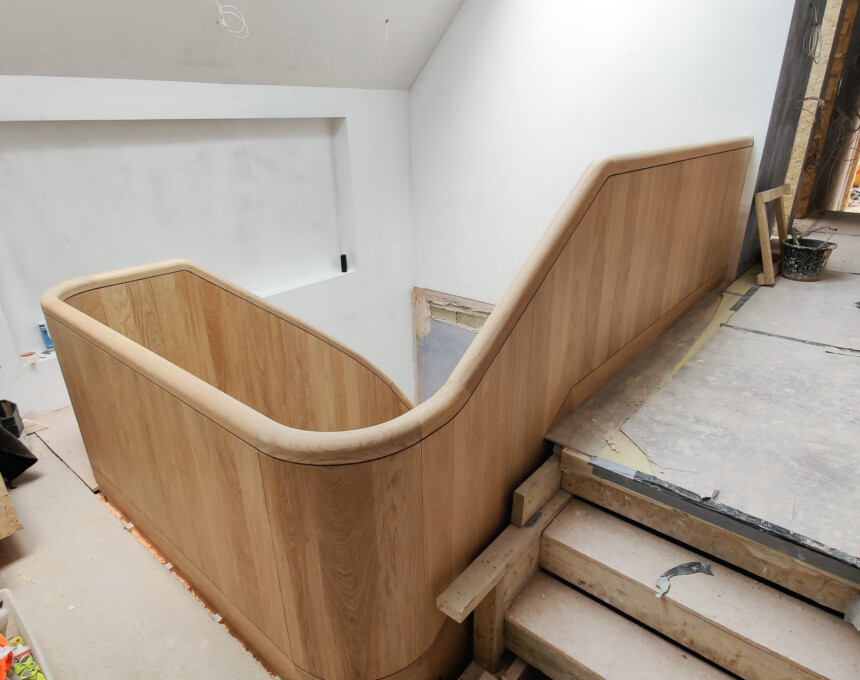
As this is one of our most recent projects, we do not have any final result pictures, yet. Follow us on social media to see the reveal pictures soon.